What happens on 22 January 2027?
Non-certified scooters are registered with their make, model and serial number, as a “vehículo no certificado” (non-certified vehicle). That registration lets them be ridden until 22 January 2027; after that date they cannot be ridden, even if they are registered (Royal Decree 52/2026, first transitional provision, and the VMP Characteristics Manual, section 33).
Until then, they have to meet the same requirements as any other scooter: to be ridden, the scooter must be registered with the DGT, carry the identification label and have third-party liability insurance (Law 5/2025).
Bear in mind, too, that a non-certified scooter cannot be taken on Renfe trains even if it is registered: since 7 September 2026, Renfe (Spain's national rail operator) only accepts scooters that are certified, registered, with the label visible and insured.
How do I know if my scooter is certified?
Look at the manufacturer's black plate: if it shows a certificate number (a letter and 4 digits, such as B1134), it is certified. You can also look the model up in our certified scooter finder (based on the DGT's list) or check the technical data sheet. We explain it step by step in how to check if your scooter is approved.
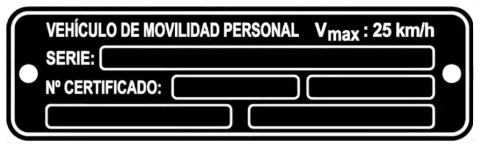
A clue: since 22 January 2024, the models on sale must be certified. Even so, non-certified scooters are still sold online, so always check.
How does a certified scooter differ from a non-certified one?
| What changes | Certified | Non-certified |
|---|---|---|
| How it is registered | With the model's certificate number, the technical data sheet and a photo of the manufacturer's plate | With make, model and serial number, as a “vehículo no certificado” |
| How long it can be ridden | Not affected by the 22/01/2027 limit | Until 22 January 2027 |
| Registration fee | €8.67 | €8.67 |
| Where the label goes | In the rear label holder (porta-identificador) | Somewhere visible |
| What it needs to be ridden | Registration, label and insurance | Registration, label and insurance |
| Can it be certified later? | It already is | Only through an extraordinary certification at an authorised laboratory |
What are your options if your scooter isn't certified?
1. Register it now and use it until 22 January 2027
It is registered as a “vehículo no certificado”, with its make, model and serial number, and the fee is the same: €8.67. You also need the identification label, which on non-certified scooters goes somewhere visible, and insurance. We register certified and non-certified scooters for €35 all inclusive, with a Spanish driving licence and no need for Cl@ve or a digital certificate (without a Spanish licence, you identify yourself with Cl@ve PIN or a digital certificate).
2. Sell it
You can sell it, but the buyer will have the same limit: after 22 January 2027 they won't be able to ride it either, so tell them beforehand. If it is already registered, the change of owner is done within 30 days: the buyer starts it, you authorise it within 72 hours and the fee is €8.67. We explain it in changing the owner of a second-hand scooter.
3. Deregister it
If you're not going to use it any more, it is deregistered at an authorised treatment facility (a scrapyard) or wherever environmental rules say (Royal Decree 52/2026, Annex XX).
4. Replace it with a certified model
If you're going to keep riding a scooter after that date, you need a certified one. Before you buy it, check the manufacturer's plate and the DGT's list: the models on sale must be certified, but not all of those you see online are.
5. Apply for an extraordinary certification
The law allows owners to ask an authorised laboratory to certify their scooter. You take it in with whatever technical documents you have (the data sheet and the manual, if you kept them); the laboratory runs non-destructive tests and sends the result, positive or negative, to you and to the DGT. If it is positive, your scooter becomes certified. Price and turnaround depend on each laboratory; the list of authorised laboratories is on the DGT website (in Spanish).
Want to use it until 22 January 2027?
We register certified and non-certified electric scooters for €35 including the fee and VAT · 100% online · certificate in under 24 hours · licensed gestoría no. 4213
Register my scooterFrequently asked questions about non-certified scooters
Until when can a non-certified scooter be ridden?
Until 22 January 2027, if it is registered with the DGT, carries the label and is insured. After that date it cannot be ridden, even if it is registered.
Can a scooter be certified later?
Yes, exceptionally. Owners can ask an authorised laboratory to certify their scooter: they take it in with whatever technical documents they have, the laboratory runs non-destructive tests and the result can be positive or negative.
Is it worth registering a non-certified scooter now?
If you're going to use it before 22 January 2027, yes: without registration and a label the scooter cannot be ridden legally or insured. The fee is the same as for a certified one, €8.67.
Are scooters bought before 2024 certified?
Not necessarily. Since 22 January 2024, the models on sale must be certified; earlier ones may or may not be, depending on the model. Check the manufacturer's plate or the DGT's list.
Where does the label go on a non-certified scooter?
Somewhere visible. The rear label holder, under the light and tilted at 30°, is the position for certified scooters.
What do I do with it after 22 January 2027?
You will no longer be able to ride it. You can deregister it at an authorised treatment facility (a scrapyard) or wherever environmental rules say.
Official sources (in Spanish)
- Royal Decree 52/2026 (BOE, 30/01/2026): rules for non-certified scooters (first transitional provision), label, change of owner and deregistration (Annex XX), and extraordinary certification (annex XIX, section 5).
- VMP Characteristics Manual: certificate number (section 31) and non-certified scooters (section 33).
- DGT online office: VMP registration: documents and the €8.67 fee.
- DGT online office: change of owner of a VMP: deadline, fee and the seller's authorisation.
- Law 5/2025 (BOE, 25/07/2025): compulsory insurance.
- Renfe (September 2026): only accepts scooters on trains if they are certified, registered, labelled and insured.