Looking for something else?
Whether it is already registered with the DGT → Is my scooter registered?
Where the certificate number is → DGT certificate number
Are “approved” and “certified” the same thing?
Yes, in practice. The rules for personal mobility vehicles (vehículos de movilidad personal, or VMPs) talk about certified scooters, and in everyday Spanish people say “homologado” (approved). Certification applies to the model, not to each unit: the manufacturer requests it and it is identified by a certificate number.
A VMP is a single-seat vehicle with an electric motor, designed to travel at between 6 and 25 km/h, with up to 1,000 W of power (2,500 W if self-balancing) and weighing less than 50 kg.
Method 1: the manufacturer's black plate
Certified scooters carry a black metal plate from the manufacturer, not a sticker. It shows:
- The certificate number: the testing laboratory's letter and 4 digits, e.g. B1134. For an individual certification, the laboratory letter, a U and 4 digits.
- The serial number, which is unique to each scooter.
- The maximum speed: 25 km/h.
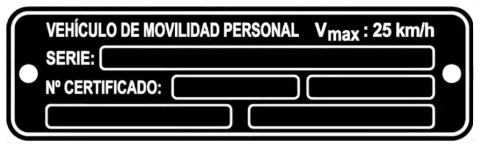
Where is it? It is usually at the base of the stem (where it joins the deck), under the deck where you put your feet, or near the rear wheel.
Method 2: the DGT's list (without the scooter in front of you)
On its personal mobility vehicles page (in Spanish), the DGT publishes the list of certified models. To find it faster, use our certified e-scooter finder, which uses the same list. Search for the exact make and model: if it appears, it is certified. Note down the certificate number, because you will need it to register the scooter.
Method 3: the technical data sheet, the manual or the invoice
Look for the certificate number on the technical data sheet (ficha técnica), the manual or the purchase invoice. If your scooter is certified, the technical data sheet should show it: it is exactly what the DGT asks for to register the scooter, together with a photo of the manufacturer's plate.
Method 4: the purchase date
Since 22 January 2024, the models on sale must be certified. If you bought yours after that date, it probably is. Even so, non-certified scooters are still sold online, and those bought earlier may or may not be: confirm it with method 1 or 2.
Summary: is it certified or not?
| Sign | Certified | Non-certified |
|---|---|---|
| Manufacturer's black plate with a certificate number | Yes | No |
| The model appears on the DGT's list | Yes | No |
| Certificate number on the technical data sheet or the invoice | Yes | No |
| Bought after 22/01/2024 | Likely | Possible: check the plate or the list |
What do I do if my scooter isn't approved?
You have until 22 January 2027. Until that date it can be ridden if it is registered with the DGT, carries the identification label (somewhere visible) and is insured. It is registered as a “vehículo no certificado” (non-certified vehicle), with its make, model and serial number, and the fee is the same as for a certified one: €8.67.
Do I need to know if it's approved to register it?
Yes, because it changes what the DGT asks for. If it is certified: the technical data sheet with the certificate number and a photo of the manufacturer's plate. If not: make, model and serial number. In both cases you pay the same fee, €8.67, and you get a registration number in the format M 0000 AAA. How to do it, in the guide to registering your scooter with the DGT.
Know if it's certified? Now register it
Certified or not, we register your electric scooter for €35 including the fee and VAT · 100% online · certificate in under 24 hours · licensed gestoría no. 4213
Register my scooterFrequently asked questions about scooter approval
Where is the certification plate on my scooter?
It is usually at the base of the stem, under the deck where you put your feet, or near the rear wheel. It is a black metal plate from the manufacturer, not a sticker.
What does the certificate number look like?
It is the testing laboratory's letter followed by 4 digits, e.g. B1134. For an individual certification, it is the laboratory letter followed by a U and 4 digits.
My scooter isn't on the DGT's list. Can I get it certified?
Yes, exceptionally: you can ask an authorised laboratory, which will test your scooter and give a positive or negative result. If it was sold before 22 January 2024, you can also register it as non-certified and ride it until 22 January 2027.
Does a scooter have to be approved to be registered?
No. Both can be registered: non-certified scooters as a “vehículo no certificado” (non-certified vehicle), with make, model and serial number. But they can only be ridden until 22 January 2027.
What happens if I ride a non-approved scooter after 2027?
From 22 January 2027, non-certified scooters cannot be ridden, even if they are registered. If you want to keep riding a scooter, you will have to replace it with a certified model.
Can a second-hand scooter be certified?
Yes. Certification belongs to the model, not to the owner: if the model is certified, it stays certified even when the scooter changes hands. Check the manufacturer's plate or the DGT's list.
Official sources (in Spanish)
- VMP Characteristics Manual: what a VMP is (section 2), certificate number (section 31) and non-certified scooters (section 33).
- Royal Decree 52/2026 (BOE, 30/01/2026): compulsory registration and the rules for non-certified scooters (first transitional provision).
- DGT: personal mobility vehicles: list of certified models.
- DGT online office: VMP registration: documents and the €8.67 fee.