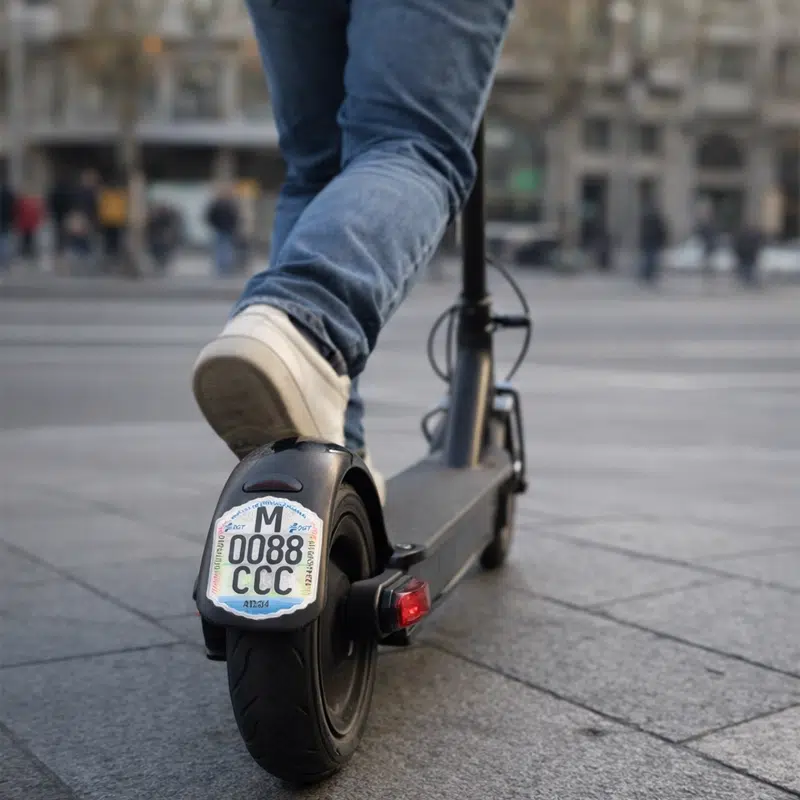
“Approved” and “certified VMP”: are they the same?
Yes. The official DGT terminology is certified VMP (Personal Mobility Vehicle), but in everyday speech “approved”, “certified”, “DGT-approved” or “with circulation certificate” are used interchangeably. They all refer to the same status: the manufacturer or importer has submitted that model to a technical verification process and the DGT has issued an official certificate proving it complies with the VMP Characteristics Manual.
What that certificate guarantees: maximum speed limited to 25 km/h, motor power within legal limits, weight under 50 kg, and safety systems (brakes, lights, signals) complying with regulations.
Method 1 — The black marking plate (the most reliable)
The definitive indicator is physical: certified scooters carry a black metal plate fixed at the factory to the frame. It is not a paper sticker or plastic adhesive — it is a laser-engraved plate that includes:
- DGT certificate number — alphanumeric format: letter + 4 digits (e.g.:
e1*0042,A0125) - Serial number — unique to each unit
- Brand and model
- Year of manufacture and maximum speed (25 km/h)
Where is it? Check these three common locations:
- Base of the mast — the vertical bar where the handlebars are, just where it meets the deck
- Underside of the deck — below the platform where you rest your feet
- Rear mudguard area or near the motor
Method 2 — The official DGT list (without the scooter in front of you)
The DGT maintains a publicly available and up-to-date official list of all certified VMP models. This is the definitive method to check whether a model is approved without needing the scooter physically present.
How to use it:
- Go to dgt.es and find the “Personal Mobility Vehicles (VMP)” section
- Download the Excel or PDF file with the updated list
- Search for the exact brand and model of your scooter
- If it appears, it is certified. Note the certificate number: you will need it for registration
Method 3 — Manufacturer documentation and invoice
If you have the purchase invoice, user manual or access to the manufacturer's official website, look for any reference to a DGT certificate number. Certified models always include it in their technical documentation.
You can also check the technical data sheet for your model on the manufacturer's page: if it complies with Spanish regulations, they will mention it explicitly with the corresponding certificate number.
Method 4 — The purchase date rule
There is a rule of thumb that works in most cases:
- Bought after 22 January 2024 from an official shop (physical or online, in Spain): it is almost certainly certified. Since that date, the law requires distributors to sell only certified models.
- Bought before 22 January 2024, or acquired second-hand, via direct import or unofficial channels: it may or may not be certified. Use methods 1 or 2 to confirm.
This rule is not foolproof — some distributors sold uncertified stock even after the deadline — but it is a good quick starting point.
The DGT “VMP CERTIFIED” seal
Certified scooters may display this logo on their box, manual or technical sheet. But the only valid and verifiable indicator is the physical plate on the frame and the model appearing on the official DGT list.
Summary table: certified or not?
| Sign | Certified | Not certified |
|---|---|---|
| Black metal plate on the frame | ✓ Yes | ✗ No |
| Appears on the official DGT list | ✓ Yes | ✗ No |
| Certificate number on the invoice | ✓ Yes | ✗ No |
| Bought after 22/01/2024 from official shop | ✓ Likely | ⚠ Verify |
What do I do if my scooter is NOT approved?
Do not panic: you have more than a year's leeway. The DGT established a transitional regime that allows continued riding of non-certified scooters under these conditions:
- Register it with the DGT before 22 January 2027 (process that started on 30 January 2026)
- Obtain the identification label
- Take out compulsory third-party liability insurance
The registration is exactly the same as for certified scooters, with minor documentation differences: instead of the certificate number, you only need the serial number and a photo of the plate or technical data sheet.
Do I need to know if it is approved to register it?
To start the registration you only need to know the type of scooter (certified or non-certified), which determines the documentation you must submit:
- Certified: DGT certificate number + serial number
- Non-certified: serial number + photo of plate or technical data sheet
In both cases the result is the same: an official registration number (format M 0000 AAA) and the DGT PDF certificate that allows you to take out insurance and obtain the identification label. The official DGT fee (8.67 €) is identical for both types.
Already know if it is approved? Now register it
Certified or not, we register it for 29.95 € all included · No Cl@ve · 24–48 h · Registered agency no. 4213
Register my scooter nowFrequently asked questions about scooter approval
What is the difference between a DGT-approved and a certified scooter?
None: they are exactly the same. The official DGT terminology is “certified VMP”, but in everyday use “approved”, “certified” or “DGT-approved” are used interchangeably.
What does a DGT certificate number look like?
It has an alphanumeric format: a letter followed by 4 digits (e.g.: e1*0042). This number is unique to each model and appears both on the physical plate of the scooter and on the DGT's official list. If the number on your plate appears in the list, the certification is genuine.
My scooter does not appear on the DGT list. Can I certify it?
Not directly. Certification is processed by the manufacturer or importer with the DGT, not by the individual owner. If your model is not on the list, you cannot certify it retroactively. You can register it as “non-certified” and ride until 22 January 2027.
Does the scooter need to be approved to register it?
No. The DGT allows both certified and non-certified scooters to be registered. Non-certified ones receive a transitional registration valid until 22 January 2027. The process is practically the same for both. See full differences in registration →
What happens if I ride a non-approved scooter after 2027?
From 22 January 2027, only officially certified VMP vehicles will be allowed on public roads. Riding an unauthorised VMP carries fines of 200 to 800 € under RD 52/2026.
Can second-hand scooters be certified?
Yes. Certification belongs to the model, not the owner or specific unit. If the model has a DGT certificate, all units of that model are certified, regardless of how many times they have changed hands. Verify by looking for the black plate or checking the official list.
Based on RD 52/2026, Law 5/2025 and the DGT VMP Characteristics Manual. March 2026. Written by Xavier Ilincheta Ferrer, Registered Administrative Agent no. 4213.